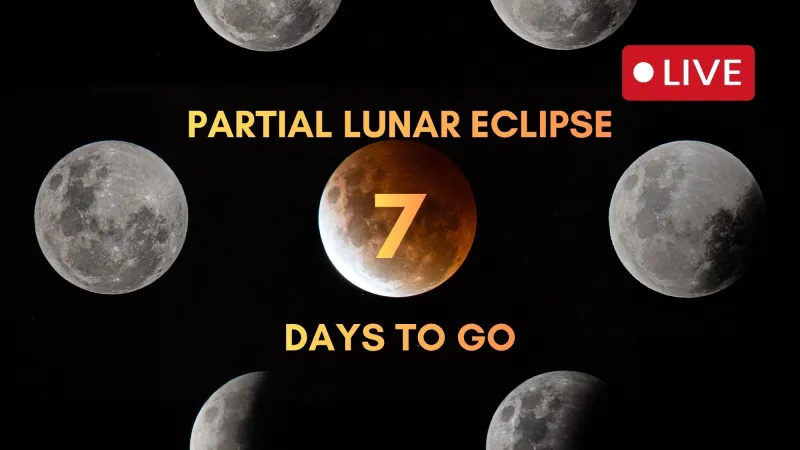
Skywatchers across the Americas, Europe, Africa, and parts of Asia are in for a treat on the night of August 27-28, 2026, as a deep partial lunar eclipse will be visible. This event occurs when the Sun, Earth, and Moon align, with the Moon passing through the Earth's umbral shadow. Unlike a total eclipse, only a portion of the Moon will be covered, but this partial eclipse is expected to be particularly deep, with a large fraction of the lunar disk darkened.
According to timeanddate.com, the eclipse will begin at 02:23 UTC on August 28, with maximum eclipse at 04:12 UTC, when about 93% of the Moon will be in shadow. The eclipse will end at 06:02 UTC. The entire event will last about 3 hours and 39 minutes. Observers in the Americas will see the eclipse in the evening of August 27, while those in Europe and Africa will see it in the early morning hours of August 28.
No special equipment is needed to view the eclipse, but binoculars or a telescope can enhance the view. Unlike solar eclipses, lunar eclipses are safe to view with the naked eye. For the best experience, find a location with a clear, dark sky away from city lights. The Moon will appear reddish-orange during the deepest part of the eclipse, a phenomenon often called a 'blood moon' even in partial phases.
This eclipse is the second lunar eclipse of 2026, following a total lunar eclipse in March. The next lunar eclipse will be a total one on February 20-21, 2027. For those who miss this event, there will be plenty of opportunities to observe future celestial phenomena.