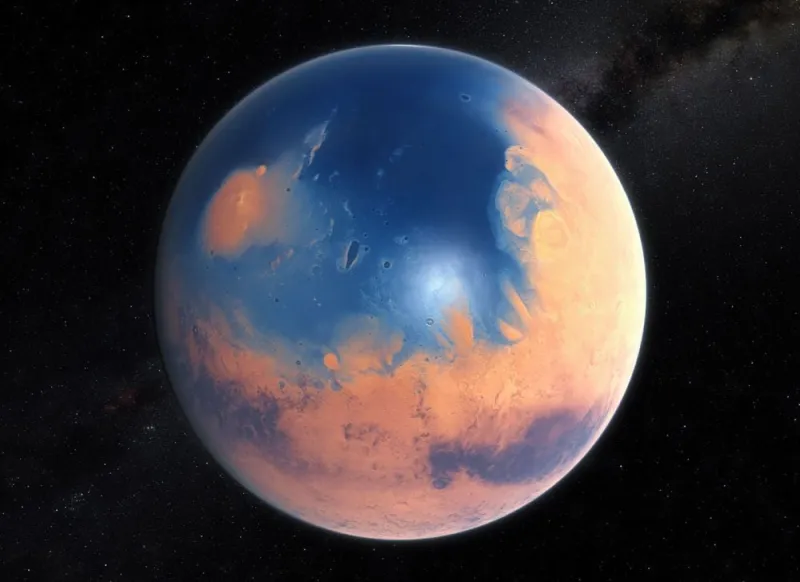
Mars holds a unique position in the Solar System as a case study for marginal habitability. Evidence from NASA's Mars rovers and orbiters indicates that the planet once had liquid water on its surface, with conditions that could have supported microbial life. Over billions of years, Mars lost most of its atmosphere and surface water, transitioning to a cold, dry world.
This transition is key to understanding exoplanets that exist at the edge of the habitable zone—the region around a star where liquid water could exist. Scientists study Mars to model how planets might lose their atmospheres and become uninhabitable, providing a comparative framework for interpreting data from telescopes like the James Webb Space Telescope.
Recent research, including studies published in journals such as Nature Astronomy and Icarus, uses Mars' geological history to predict the atmospheric evolution of exoplanets. For example, the loss of Mars' magnetic field allowed solar wind to strip away its atmosphere, a process that could occur on exoplanets orbiting active stars.
By understanding Mars' past, astrobiologists can better identify which exoplanets might have retained their atmospheres and water, and which are likely 'marginal' worlds like Mars today. This approach helps refine the search for potentially habitable planets beyond our Solar System.